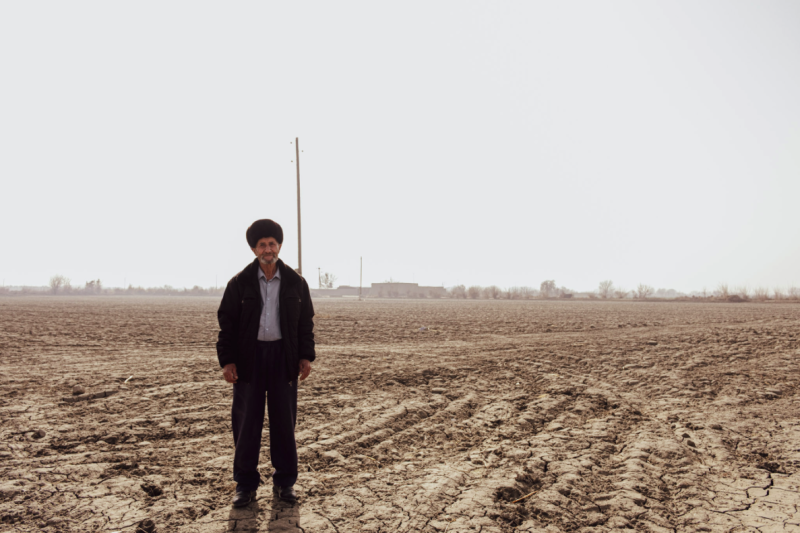
Anyone entering Termez is met with a carefully maintained illusion. Along the wide avenues, municipal workers are tending to newly laid flowerbeds, whilst dark conifers tower high above them. The contrast with the arid landscape outside the city is stark.
The looming water crisis is palpable everywhere. ‘We keep track of every drop that falls.’ Oybek points to a deep well in his yard. ‘That’s groundwater.’ A little further on, he shows a second reservoir, designed to collect rainwater. These systems are a sign of a growing problem. The irrigation canals that have provided security for generations are increasingly running dry. ‘Every bit of water we can store ourselves makes the difference between a successful and a failed harvest.’
Just how dire the situation is becomes clear in the Angor district. We follow the border with Afghanistan for kilometres. Five rows of barbed wire separate Uzbek territory from the Amu Darya River, also known as ‘the Nile of Central Asia’. Here, it forms the official border, but flows alternately through Afghan and Uzbek territory. And the river’s flow is steadily decreasing.