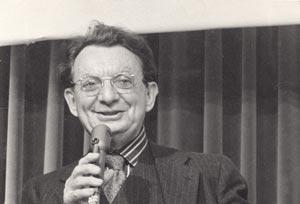
The picture of reality that he sketched week after week was, however, fundamentally different from the image all these institutions were so keen to project. It is the paradox of North American and Western democracies that someone like Stone could keep this up for so long, even as he exposed time and again the lies, the corruption and the undemocratic attitude of his country's leading authorities. And because he depended on no one's support, he was very hard to hit. Those he targeted knew they could not win a debate with someone speaking on the basis of their own data and the democratic principles they themselves publicly championed, and could only hope his voice would reach nothing more than a small core of sympathisers. But they were mistaken, for his analyses and arguments were repeatedly taken up by the opposition to that establishment, and often used with success.
Stone was, in the words of Michel Foucault, a perfect example of the "fearless speaker" (parrhesiastes), someone who is not only exceptionally well informed but also has the courage to keep proclaiming the truth against all pressure.
Those who look down — perhaps rightly so — on a certain kind of journalist as hired "word processors", people out to deliver easily readable copy designed above all to grab attention, forget that I.F. Stone was not the only one, then or now, who regards this fearless speech as the essence of their task. It is no coincidence, then, that journalists, alongside social workers and liberation theologians, have in recent decades been among the hardest-hit victims of smear campaigns, persecution and killings in almost every regime where the authorities wanted to neutralise the power of their revealing information and analysis. They by no means constitute the so-called "fourth estate", but they are capable of making the actual powers-that-be nervous enough, by pointing out — as Socrates did — their incompetence, ignorance and/or hypocrisy, and thereby calling into question and weakening their comfortable ideological grip on the population.
In a world that is becoming ever more one-dimensional economically, politically, militarily and culturally — in that order — capable journalists face an existential choice: either they build a career by putting themselves as much as possible at the service of those in power, doing so both by defending the official "line" and by keeping their readers amused and passive (infotainment — see Bourdieu on this), or they try, through fearless speech, to strip away the deadly fairy tale of TINA (There Is No Alternative), like the Ugly Sleeping Beauty, and are prepared to bear the consequences of doing so.
Author: Ludo Abicht